Sunday, 27 October 2013

Story Time

A Hassidic parable tells about a certain rabbi who, whenever danger threatened his flock, could avert the evil by performing three rituals: going to a special place in the forest, lighting a fire and saying a prayer. When his successor needed to pray for his people’s protection, he confessed he’d forgotten how to light the fire, but he entered the forest and he said the prayer, and it was enough. The next rabbi had to confess that he had forgotten the place in the forest, and how to light the fire, but he said the prayer, and it was enough. Finally there was a rabbi who said to God, “I’ve forgotten the place in the forest, and I’ve forgotten how to light the fire, and I’ve forgotten the prayer, but I do know the story. Dear God, I hope it is enough to protect my people.” And it was enough.

“God made people because he loves stories,” concludes Jewish writer Elie Wiesel when he quotes this parable in the preface to his book The Gates of the Forest.

This past week was a good week because I heard a lot of stories. Al told me an exciting story of how Solay caught his very first fish ever when they went down to the river to fish (For another fishing story about Solay and his Opa's fishing click on the post for  Sept. 7, Let's Go Down to the River). A woman told me an amazing story about how her family was finally able to say “I love you” to each other. A friend told me a story about being a young wife and mother living in a high rise in Montreal. And here’s my story about a story that moved me:

Last Saturday, I attended a gathering of quilters from various guilds on the North Island. Among other things, we’d been challenged to create a quilt that included circles or wheels. They were all interesting in their own way, and it was hard to vote for the best. Although Marilyn’s quilt did not win the challenge, she told this story about her quilt:

The Wheels Go Round challenge quilt by Marilyn Schick.


“I grew up on a farm in southern Saskatchewan, with 3 brothers and 3 sisters. One day, my dad came home from a farm auction with his grain truck filled with wheels of all shapes and sizes. They were piled high right up to the top, and we wondered what he was planning to do with all of them. He told us to go to the small hill in the pasture, and he drove the truck to the top of that small hill, then dumped all the wheels out. They went rolling and bouncing down the hill to the bottom – what a sight! Then Dad told us they were ours to do with what we liked. Well, we put our heads together, and we decided to build a house. We built a huge house with those wheels as the walls. There was a living room, dining room, bedrooms, kitchen. Dad made some window frames for us, helped put on a roof made of boards and sheets of metal, and we hauled bales of straw to cover the floor and make furniture. The cattle often came and stuck their noses in through the doors and windows. Anytime we wanted to have a little time to ourselves, we would go to our wheel house and sit there, maybe read or play by ourselves. Our play house lasted for years. My dad was a great dad. He died in April, and this hanging, with circles bouncing all over, is a tribute to him.”

The quilt was beautiful, but it was the story that moved me. I was transported to my own childhood, when I also felt that thrill of possibilities. That’s what the best stories do -- they call up an awareness of our inner selves, and give us new insights. They help us find our common connections with others. Family stories give us a sense of roots, help us shape our identity, and let us come to understand each other. And that can only be good.  “Stories have to be told or they die, and when they die, we can't remember who we are or why we're here,” wrote Sue Monk Kidd in The Secret Life of Bees.

Any kind of art can be used to tell stories: quilts, yes, and words, of course, but painting, dance, music, theatre, film ... well, just about anything.

But all are a gift to the human race, and a gift back to the Creator who started our story.

 My thanks to Marilyn Schick of the Comox Valley Schoolhouse Quilters who generously shared her story, her gifts and her heart with us.

Saturday, 19 October 2013

The Message of the Crow

A common question people ask me is, “Why are you so interested in crows?” Sometimes they’ll follow up the question with a story about a personal encounter with crows.

“I hate crows. They kill the little animals in my garden,” says one woman. Another says, “I had an invasion of magpies (relatives of crows) in my backyard. They woke me up early every morning with their racket.” “Oh, crows!” says a saleslady at a fabric shop when I tell her that I’m looking for crow fabric. “They are too smart and scary. We wanted to tear down an old shed in our backyard, but they wouldn’t let us. They kept divebombing us.” The stories are interesting, often not complimentary, and yet most folks seem to have a reluctant admiration for these enduring birds. They are bossy, smart, sassy, and just plain fascinating.

The crow and I started our relationship earlier this year, when I was working on my Winter Tree quilt (see my post of July 7 on this blog).The addition of the crow to the top of the tree was almost accidental, and I added some beads streaming from the crow’s bill on a whim. But that’s what I love about creative work: often there are underlying messages in the end product, messages that come out of our deep subconscious. If we pay attention, we will learn something about ourselves we did not know before. The great Creator’s spirit within us knows and speaks.

I began reading everything I could find on crows. The more I researched, the more I became intrigued. I learned that crows live in family groupings, and mate for life. They are the smartest of the birds, the avian equivalent of chimps. Aesop told a fable about crows: a thirsty crow saw a pitcher of water, but the water was too low in the pitcher for the crow to get at it. So it found a pile of pebbles and dropped them into the pitcher to raise the water level until it could quench its thirst. The moral of the story: Necessity is the mother of invention. This is a great story, but it also happens to be based on reality. You can read about and see it for yourself by doing a google search on “crow drops pebbles into water.”

This is my version of Aesop's fable. The fable is written out across the bottom.


I learned that crows mourn their dead. They communicate, and somehow pass on life lessons to their children and grandchildren. They like to play, hanging upside down from branches in the breeze to swing back and forth. Yearling girl crows often stay home an extra year to help their parents care for the next year’s brood. They are, in a word, quite amazing.

I passed on what I’d learned about crows to folks who would ask, but one questioner was not satisfied. “I think they’re nasty. They tear apart our yard, they move in and take over whatever appeals to them, they’re noisy and bossy, and they’re everywhere.” That’s when the penny dropped, and the meter began ticking. Yes, crows are everywhere, and sometimes we think they’ve taken over the world. But if we gave Mother Nature a chance to voice her opinion about us, wouldn’t she say the same thing? We human beings have appropriated the earth and act as though it’s ours to do with what we like. We’re noisy, we’re bossy, we’re persistent, and we’re not about to go away anytime soon.

Crows are plentiful in our urban environment because they have learned to adapt. So have we. They moved from rural to urban environments when we did. They have pushed other wildlife to the side in their search for room. So have we. They are not good, they are not bad, they just are. They are so much like us, it’s scary.

Now, when I see a crow, I am reminded of ... me. The crows send me a message of huge importance. We are not alone on this beautiful planet  We are connected in ways too numerous to count – we breathe the same air, drink the same water, and depend on each other as we dance this delicate dance of life. What are we doing to make room for all God’s creatures?

The crow and I have started a journey in this special year, one that I suspect will lead me into new territory. Thanks for allowing me to share that journey with you.

Sunday, 13 October 2013

Thanksgiving? Yes!

Several years ago, with Thanksgiving approaching, I sat down to write a letter to our four children. I’d made a practice of sending out a group e-mail regularly letting them know what was new on the home front. I was not a happy camper – all of them were scattered around the world, and they would not be home for Thanksgiving. Poor me!

So I began: “Dear kids, What with Thanksgiving approaching, I thought I should start this letter by listing some of the things for which I am grateful...” Two pages later, I still wasn’t finished, and I was in a much better frame of mind. I discovered that an attitude of gratitude is self-perpetuating. The more you give thanks, the more you want to give thanks. I discovered what psychologists have known for a long time: gratitude is good for your physical, spiritual,  emotional, mental and social health.

This week, with Thanksgiving approaching, I thought it would be a pleasure to write a warm, witty, light-hearted post. Something along the lines of Why I Love Thanksgiving or even Why I Don’t Love Pumpkin Pies (for your chuckle of the day, google images for Why I Don't Like Pumpkin Pie.)

I had a good quilt piece already made that fit very nicely with the theme. I created this piece, featuring a cornucopia full of words, 5 years ago, as part of a quilt celebrating the year I turned 60. It’s a true and accurate picture of my feelings at the time. That Thanksgiving Day, we were celebrating family and blessings together. It was good, very good, and my heart was full and overflowing. Around the cornucopia I wrote “Oh give thanks to God for he is good.”


 But yesterday, I got some bad news. Someone who is dear to many people, including us, has just been given a very bad cancer diagnosis. My grief at the news reminded me that life is not always warm and light-hearted, and that writing something witty and clever for Thanksgiving would be a cop out for me. Thanksgiving plumbs depths much deeper and darker than sweet sentiments can express. 

How do you celebrate thanksgiving when parts of life are so wrong, when the World Trade Towers fall, when the tsunami kills 16,000 of your countrymen, when your spouse is coping with a devastating disease, when the environment is going to hell in a handbasket? I still believe God is good, but I have so many questions, the same questions that all of humankind has been asking since the beginning of time: Why? What’s this all about? I don’t understand. I grope toward answers, and lean on my belief that this good God is with us through it all.  But the bottom line is that life is a mystery, and we won’t have definitive answers this side of eternity

What I do know is that life is a mixture of sunshine and shadow, gold and garbage, joy and sadness. Amongst the cornucopia of blessings we experience –  and there are so very, very many – we need to acknowledge the black ribbon that is woven through it. We rejoice with those who rejoice, but we also mourn with those who mourn. And in the middle of it all, though we do not give thanks for the tragedies and perplexities, we can give thanks in them.* We can choose to focus on the grace amidst the garbage, to see shafts of light in the darkness, and to give thanks for all that is good and wonderful in this life.

And the prayers of thanksgiving we utter in the dark times will help us through to the light.


I made a new quilt piece for this post, a new cornucopia to fill. I have written words on the scrolls and tied them with ribbons of varied colours. I placed these prayers of thanksgiving in the basket, saying thanks for good times, but also for the good that I found in the bad times. What’s in your cornucopia today?

* Thanks to Charleen for this insight – she is blogging about her father’s illness which has turned their lives upside down. In her blog, she began listing what she is thankful for, and like me, it was hard to stop once she got started.
The prayer that is inscribed on the new cornucopia is an excerpt from one by Vienna Cobb Anderson, plus ideas and thoughts of my own. You can read Anderson’s prayer at www.beliefnet.com/Prayers/Christian/Gratitude/Prayer-Of-Thanksgiving.aspx


Saturday, 5 October 2013

The Farther You Go...

I love to travel...to poke around the world and see what there is to see, to reflect on new ideas and lifestyles, to be challenged and to feel awe and wonder as I experience  “aha” moments of discovery.

Our two weeks in Nova Scotia gave us lots of “aha” moments. We will never forget the late night guided graveyard tour in Annapolis Royal when the heavens suddenly opened and rain quenched the candles in the lanterns. The voices of new immigrants telling their poignant stories at Pier 21, where almost a million people set foot on Canadian soil for the first time, will echo in our minds. And we will smile at the memory of the old red phone box plunked in the middle of a vineyard, where we were invited to make a free call to anyone in the US or Canada.
Being skinflint Dutchies, we did, of course, and wondered if we could get away with making a few more; being guilt ridden Calvinists, of course we didn’t try.

I like what St. Augustine said: “The world is a book, and those who do not travel read only one page.” There are times when I just long to gobble up every page in that book, and hope there’s a library of more.

So I was taken up short when I read these words in Inspired Rug Hooking by artist Deanne Fitzpatrick: “We need to believe in the value and importance of our own lives, and the way we do things, and what we have around us. We need to sit on our own front stoops to find ourselves first before we set off on some transcontinental journey. The way home is in your own breath and in your own stillness.”

I don’t think Deanne Fitzpatrick is telling us to quit traveling. Rather, if I read her right, she is saying that if we are travelling just to escape what we consider our own mundane life, we might be better off first to take a close look at the life that is around us right here, right now. If we are bored with that, all the journeys in the world won’t give us lasting pleasures. There are life-enriching  discoveries to be made right in our own backyard, if we’ll only cultivate an awareness of possibilities.

Case in point: one morning, a week before we were going to depart on our Maritime trip, I woke up to find our yard bedecked by hundreds of spider webs. They were draped over the evergreen shrubs like white handkerchiefs made of gossamer threads. They were hanging between shrub and post, finely woven in dew-drenched silk. The yard was booby-trapped with sticky invisible threads that suddenly wrapped themselves around me as I unsuspectingly crossed the patio or opened a door. It felt like the spiders had dropped in overnight in their silk parachutes, invading the country of our backyard.


my idea of a spider and spiderweb, stitched on a crazy quilt

When I did a little research into what was going on, I found out that, no, there were no more spiders than there normally are – but the weather changes had made their webs more visible. Also, spiders were nearing the end of their life cycle, and were feverishly trying to pack it all in (reminding me of myself, as I become more aware of the passing of time!) I also learned  fascinating myths and stories about spiders that got me thinking about spiritual things, but that’s for another blog. What had begun as a small visible experience became an inner journey. Sitting on my own stoop had launched me on a voyage of discovery of a different sort than any exotic journey, but valuable none-the-less.

And here’s the bonus: weeks later, as were hiking the seashore in Nova Scotia, with a continent stretching between us and home, I discovered ... spiders! They had stretched webs between the bushes lining the cliff, and there were dozens of them within a square meter, all doing their thing.


The farther you go, I discovered, the closer you may be to home!


Saturday, 28 September 2013

In Pursuit of Treasure

So, as I write this, the old guy has been traipsing around Nova Scotia with his new woman for more than a week. Only trouble is, this new woman is exhibiting many of the traits that the old woman had.
                                   
To whit: she needs to stop at every fiber-related shop, studio, gallery and supply place she sees. This includes a LOT of places here, because it seems like every other shop is related to the arts. What’s an old guy to do? It’s enough to drive one to drink. Fortunately, just down the street from one of our
stops, Suttles and Seawinds,  there’s a liquor store. So while the new woman browses through this iconic quilt studio, he’s sent off to buy a bottle of wine, then finds himself a bench to wait.

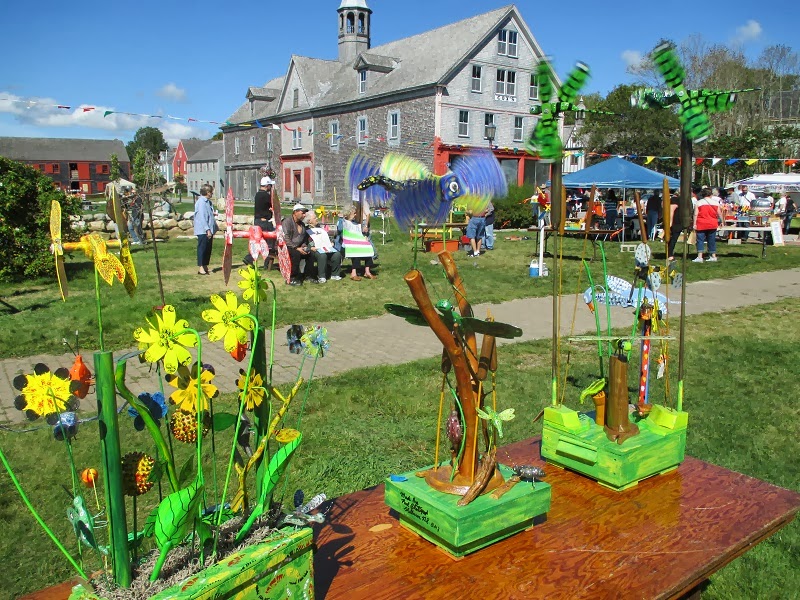
Now, it appears that a guy waiting on a bench outside a quilt store is not an uncommon sight. Al is joined by a fellow from Michigan whose women saw the sign and just had to stop “for a minute.” The men begin to chat, sharing stories, and it turns out after this stop, the Michiganders are headed for Shelburne, where there’s a whirligig festival. Al’s ears perk up. Whirligigs are made of wood, and that’s his thing. When I come out of the shop, I find that our plans have changed. See what happens when you leave an old guy alone for a minute? No more quilt shops today: we’re headed 2 hours down the road to check out the whirligigs.

And so it goes. Nova Scotians are a creative lot, and we’ve
admired their paintings, sculptures, folk art, quilts, woodwork, pottery, jewellery, hooked rugs and more. We’ve even bought a few things. Which has got me thinking: why is it that I feel a compulsion to check out these fibre-related venues, and why are we drawn to these galleries and exhibits? Are we just in search of souvenirs to take home? I think there’s more to it than that.

Rags to Riches: Words and Works by Laurie Swim, a book I picked up in Swim’s Lunenburg quilt gallery, gives a clue. In the introduction, artist Mary Pratt reflects on the way “it used to be”: people sewed, hooked rugs, worked with wood, metal and clay to make the necessities of life. Now, we have easy access to  just about everything we could want or need in mass quantities:  blankets made in China, tools sold at Canadian Tire, factory-produced mufflers for our cars and bowls to serve our dinners. And yet we long for whirligigs and thingamajigs, for hand-turned bowls and hand-shaped teapots and hand-stitched fibre art.

Pratt continues, “How right, that now, when the actual requirement for handmade items no longer exists,  creativity and the desire to add some truth of beauty still remain.” That phrase “the truth of beauty” seems so right. When we visit galleries or whirligig festivals, somehow, mysteriously, we catch glimpses of the true nature of things  – the stretching for something more, the way things could be. Maritime artist Deanne Fitzpatrick, who hooks gorgeous rugs, writes, “Art is about transformation. For me, it is about seeing the ordinary and finding the beautiful ... I believe there is meaning in beauty, and that in life we seek beauty as much as anything.”

Aha! So that explains my feeling of awe when I walked into Gaspereau Valley Fibres. The farm  wool shop features rough-hewn beams, wooden floors, and is awash in colour and texture. It is pure beauty packed into bins and packages, hanging from the ceilings and spilling out to the floor. My senses are saturated with dreams of what I could do with all those fibres, once I get them home.


I bought some, of course, a hank of roughly-spun nubby fibres, so fresh off the sheep’s back it still has bits of hay stuck in it, but dyed in multiple hues of earthy blues, browns and purples. All in the pursuit of beauty, naturally. And that’s the truth!
                              
Some more of the beauty we saw.  Thanks, Nova Scotia artists, for sharing your visions of beauty.


Windy and wild at Shelburne's Whirlygig Festival
                       
Stained glass window: Tree of Seasons


Saturday, 21 September 2013

A Hairy Tale

I have a multitude of shortcomings, but I’m proud that vanity is not high on the list (pride, however, is another thing.) I’m okay with my average looks, and I’m not big on fashion or make-up. If I’m a little bit vain about anything, it just might be my hair.


An early photo of me shows a child with a thick mop of blonde curls. In high school and college, when everyone was wearing smooth page-boy hairstyles or letting it hang long and straight down their backs, I hated my hair. I wanted to look like everyone else. But now I realize how lucky I am to have thick curly hair that needs a minimum of attention.

But what to do now that I’m a woman of a “certain age” whose crowning glory is fading and non-descript in colour? Fortunately, some genius invented hair dye. There’s a school of thought that says that dye jobs are the worst of age-ism and sex-ism combined and we should all go au naturel (when it comes to hair, only, of course.) Be proud of those gray hairs – you’ve earned them, they say. But au naturel for me is grizzled gray and drab brown, and those are not my colours. I don't wear them, and I don't use them in my quilts, so why should I have them on my head? I don’t mind flaunting my age, but not the depressing colours. A dye job 3-4 times a year is cheaper than therapy.

Self-portrait at 60. Really, would you want to go out in public with hair like that?
The resident sweetie, on the other hand, has no relationship with his hair. It used to be thick and curly and a lovely shade of brown. Now it’s thin and gray, but I don’t think he gives it a thought. In fact, he ignores his hair, except for giving it a good brushing every morning. When it grows long and scruffy, and sticks out in wings over his ears, the battle begins. “Time for a haircut,” I say cheerfully. He ignores me. “So which day did you say you were you going for a haircut?” I ask slyly. He glares at me and says nothing. I pull his hair back and tell him just a few more weeks of growth and he can wear a pony tail. He shakes me off with a grunt. For several weeks the stand-off continues. Then one day, he’ll come home from the barber with his ears lowered, and we’ll live in peace for another few months.

Last week we were at the apex of the hair issue. We’ll be visiting family during a holiday out east. Hair care was on the to-do list for both of us. I began reminding him early, and he ignored me early and late. But finally, one day, he came home from errands sporting a haircut. Enough time had elapsed since the last one that a full half inch of white neck was showing above the tan. But why quibble about details? He looked good, and I was chagrined, because for once, he’d beaten me to the draw. The grizzled me had emerged several weeks earlier, and I’d waited too long to hide it.

The next day I got to work. I mixed up the stuff, but when I applied it, the goop looked purple instead of the usual reddish orange. Apparently, I’d bought a different colour from my usual Mid Brown #865. Oh well, how bad could it be? When the job was done, I brushed the wet hair so it could air dry while I went about my daily work. Half an hour later, I walked past a mirror and did a double take. Who was that woman with the black wig? She looked like an old lady with a bad paint job. Surely that couldn’t be me? It was, and it was bad. The resident sweetie gasped and  raised his eyebrows in horror. It was very bad.

What’s that they say about pride? Something about it going before a fall? Yup.

Later that day, when I went for my haircut, my hairdresser told me it looks great – it really makes my eyes look bluer. (This woman deserves her tip, that’s for sure.) She suggests I tell Al he’s a lucky guy and he should take his new woman out to supper. I think that’s the line we’ll go with till the colour fades: he’s got himself a new woman.

Years from now, after we’re gone, when the grandchildren are sorting through the old photos, they’ll come across shots of us traipsing around the Maritimes, my neatly coifed sweetie with his new woman. They’ll be mystified. “Who’s that woman with Opa? That’s not Oma, is it? But it must be. She looks like she’s wearing a wig.”


And we're off on our grand adventure, the old guy and his new woman.


PS Since writing this, I’ve “come out” in public. Last Sunday, a friend sitting behind us at church tapped me on the shoulder and, with his eyebrows raised in admiration, commented, “Foxy!” Our son says I must be channelling my inner old crow. Hmm. Not so bad after all? Maybe Ash Brown #860 will be my new colour.


Saturday, 14 September 2013

Serendipity

Once in a while, just when you aren’t expecting it, the bits and pieces of your life come together to make a whole and beautiful moment. I love it when that happens. It could be called serendipity: “the accident of finding something good or useful while not specifically searching for it,” says Wikipedia, 

But to me,  it’s even more than that. In fact, Wikipedia says that the word serendipity has been listed as one of the top 10 words that are hard to define, and I’d have to agree. Whatever its meaning, I love it when serendipity happens. You can’t look for it, you can’t plan it, but when it occurs, you know it, and it feels so good. Heavenly, actually.

I appliqued these eagles to a silk cushion cover.
Scene One: 
On Sunday morning we are  leaving the house to go to church, when we hear a high-pitched whistling call in the clear air. Five eagles are sitting in the top of a dying tree across the road, and more are winging their way back and forth over the rushing river waters. The eagles are in our neighbourhood because the salmon have returned from their sojourn in the ocean and are beginning their run up the Puntledge, returning to their birthplace to spawn and die. Thousands are filling the river, and when they’ve  completed their mission, their spent carcasses will litter the shallows, ripe picking for the eagles. The cycle of the seasons is continuing, as it has for millennia.


 Scene Two: We are driving to church. The light is soft and golden and the sky is a cloudless blue, as it can only be on a warm Sunday in September. The leaf colours have gone from a vibrant green to muted olive and amber. Goldenrod, Queen Anne’s lace and the last of the tansies bloom in the ditches, and scarlet rosehips adorn the bushes. We bask in the beauty all the way to church.


An experimental thread study of Queen Anne's Lace flowers.


Scene Three: We are sitting in church, and the choir anthem is a song popularized by Cat Stevens but actually written by children’s author Eleanor Farjeon back in 1931 as a morning hymn. The choir is in fine form, and I close my eyes and am carried along with the melody and words that are blending with the images I’ve already experienced

Morning has broken, like the first morning
Blackbird has spoken, like the first bird
Praise for the singing, praise for the morning
Praise for the springing fresh from the word

Sweet the rain's new fall, sunlit from heaven
Like the first dewfall, on the first grass
Praise for the sweetness of the wet garden
Sprung in completeness where his feet pass

Mine is the sunlight, mine is the morning
Born of the one light, Eden saw play
Praise with elation, praise every morning
God's recreation of the new day.


I cannot put into words, I cannot define the sensation I experienced listening to that simple and yet profound tribute to creation and the Creator. For a moment, I felt that the world came together in a beautiful whole.

It was “an accident of finding something good or useful while not specifically searching for it” ... it was serendipity.

A confession: after writing this, I actually thought of retitling this piece A Numinous Experience (because that’s what it really was, besides being serendipitous.) But I figured nobody would read a blog with such a lofty title. I used to get really riled when people dropped that word into conversation; it sounded so airy-fairy, artsy-fartsy, woo-woo. But now I think it’s a wonderful word, and maybe someday I will write about it. You've been warned!