Saturday, 28 September 2013

In Pursuit of Treasure

So, as I write this, the old guy has been traipsing around Nova Scotia with his new woman for more than a week. Only trouble is, this new woman is exhibiting many of the traits that the old woman had.
                                   
To whit: she needs to stop at every fiber-related shop, studio, gallery and supply place she sees. This includes a LOT of places here, because it seems like every other shop is related to the arts. What’s an old guy to do? It’s enough to drive one to drink. Fortunately, just down the street from one of our
stops, Suttles and Seawinds,  there’s a liquor store. So while the new woman browses through this iconic quilt studio, he’s sent off to buy a bottle of wine, then finds himself a bench to wait.

Now, it appears that a guy waiting on a bench outside a quilt store is not an uncommon sight. Al is joined by a fellow from Michigan whose women saw the sign and just had to stop “for a minute.” The men begin to chat, sharing stories, and it turns out after this stop, the Michiganders are headed for Shelburne, where there’s a whirligig festival. Al’s ears perk up. Whirligigs are made of wood, and that’s his thing. When I come out of the shop, I find that our plans have changed. See what happens when you leave an old guy alone for a minute? No more quilt shops today: we’re headed 2 hours down the road to check out the whirligigs.

And so it goes. Nova Scotians are a creative lot, and we’ve
admired their paintings, sculptures, folk art, quilts, woodwork, pottery, jewellery, hooked rugs and more. We’ve even bought a few things. Which has got me thinking: why is it that I feel a compulsion to check out these fibre-related venues, and why are we drawn to these galleries and exhibits? Are we just in search of souvenirs to take home? I think there’s more to it than that.

Rags to Riches: Words and Works by Laurie Swim, a book I picked up in Swim’s Lunenburg quilt gallery, gives a clue. In the introduction, artist Mary Pratt reflects on the way “it used to be”: people sewed, hooked rugs, worked with wood, metal and clay to make the necessities of life. Now, we have easy access to  just about everything we could want or need in mass quantities:  blankets made in China, tools sold at Canadian Tire, factory-produced mufflers for our cars and bowls to serve our dinners. And yet we long for whirligigs and thingamajigs, for hand-turned bowls and hand-shaped teapots and hand-stitched fibre art.

Pratt continues, “How right, that now, when the actual requirement for handmade items no longer exists,  creativity and the desire to add some truth of beauty still remain.” That phrase “the truth of beauty” seems so right. When we visit galleries or whirligig festivals, somehow, mysteriously, we catch glimpses of the true nature of things  – the stretching for something more, the way things could be. Maritime artist Deanne Fitzpatrick, who hooks gorgeous rugs, writes, “Art is about transformation. For me, it is about seeing the ordinary and finding the beautiful ... I believe there is meaning in beauty, and that in life we seek beauty as much as anything.”

Aha! So that explains my feeling of awe when I walked into Gaspereau Valley Fibres. The farm  wool shop features rough-hewn beams, wooden floors, and is awash in colour and texture. It is pure beauty packed into bins and packages, hanging from the ceilings and spilling out to the floor. My senses are saturated with dreams of what I could do with all those fibres, once I get them home.


I bought some, of course, a hank of roughly-spun nubby fibres, so fresh off the sheep’s back it still has bits of hay stuck in it, but dyed in multiple hues of earthy blues, browns and purples. All in the pursuit of beauty, naturally. And that’s the truth!
                              
Some more of the beauty we saw.  Thanks, Nova Scotia artists, for sharing your visions of beauty.
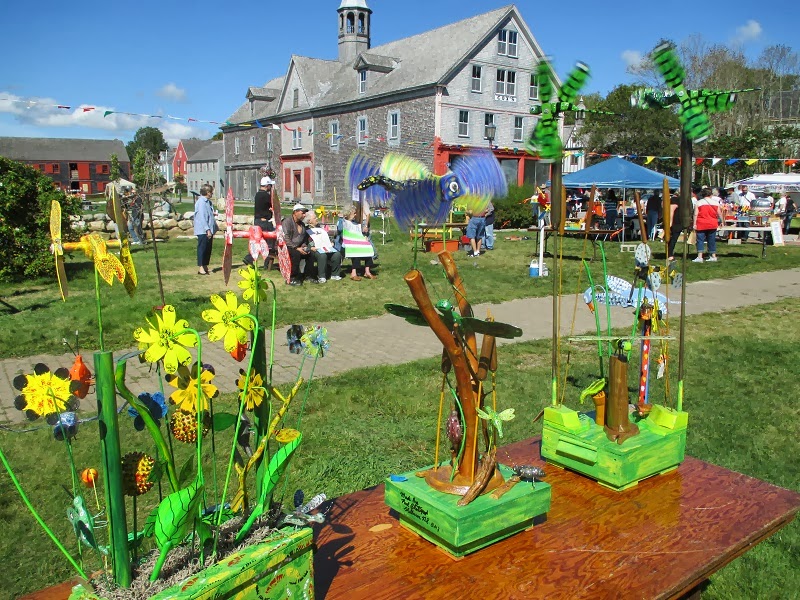


Windy and wild at Shelburne's Whirlygig Festival
                       
Stained glass window: Tree of Seasons


Saturday, 21 September 2013

A Hairy Tale

I have a multitude of shortcomings, but I’m proud that vanity is not high on the list (pride, however, is another thing.) I’m okay with my average looks, and I’m not big on fashion or make-up. If I’m a little bit vain about anything, it just might be my hair.


An early photo of me shows a child with a thick mop of blonde curls. In high school and college, when everyone was wearing smooth page-boy hairstyles or letting it hang long and straight down their backs, I hated my hair. I wanted to look like everyone else. But now I realize how lucky I am to have thick curly hair that needs a minimum of attention.

But what to do now that I’m a woman of a “certain age” whose crowning glory is fading and non-descript in colour? Fortunately, some genius invented hair dye. There’s a school of thought that says that dye jobs are the worst of age-ism and sex-ism combined and we should all go au naturel (when it comes to hair, only, of course.) Be proud of those gray hairs – you’ve earned them, they say. But au naturel for me is grizzled gray and drab brown, and those are not my colours. I don't wear them, and I don't use them in my quilts, so why should I have them on my head? I don’t mind flaunting my age, but not the depressing colours. A dye job 3-4 times a year is cheaper than therapy.

Self-portrait at 60. Really, would you want to go out in public with hair like that?
The resident sweetie, on the other hand, has no relationship with his hair. It used to be thick and curly and a lovely shade of brown. Now it’s thin and gray, but I don’t think he gives it a thought. In fact, he ignores his hair, except for giving it a good brushing every morning. When it grows long and scruffy, and sticks out in wings over his ears, the battle begins. “Time for a haircut,” I say cheerfully. He ignores me. “So which day did you say you were you going for a haircut?” I ask slyly. He glares at me and says nothing. I pull his hair back and tell him just a few more weeks of growth and he can wear a pony tail. He shakes me off with a grunt. For several weeks the stand-off continues. Then one day, he’ll come home from the barber with his ears lowered, and we’ll live in peace for another few months.

Last week we were at the apex of the hair issue. We’ll be visiting family during a holiday out east. Hair care was on the to-do list for both of us. I began reminding him early, and he ignored me early and late. But finally, one day, he came home from errands sporting a haircut. Enough time had elapsed since the last one that a full half inch of white neck was showing above the tan. But why quibble about details? He looked good, and I was chagrined, because for once, he’d beaten me to the draw. The grizzled me had emerged several weeks earlier, and I’d waited too long to hide it.

The next day I got to work. I mixed up the stuff, but when I applied it, the goop looked purple instead of the usual reddish orange. Apparently, I’d bought a different colour from my usual Mid Brown #865. Oh well, how bad could it be? When the job was done, I brushed the wet hair so it could air dry while I went about my daily work. Half an hour later, I walked past a mirror and did a double take. Who was that woman with the black wig? She looked like an old lady with a bad paint job. Surely that couldn’t be me? It was, and it was bad. The resident sweetie gasped and  raised his eyebrows in horror. It was very bad.

What’s that they say about pride? Something about it going before a fall? Yup.

Later that day, when I went for my haircut, my hairdresser told me it looks great – it really makes my eyes look bluer. (This woman deserves her tip, that’s for sure.) She suggests I tell Al he’s a lucky guy and he should take his new woman out to supper. I think that’s the line we’ll go with till the colour fades: he’s got himself a new woman.

Years from now, after we’re gone, when the grandchildren are sorting through the old photos, they’ll come across shots of us traipsing around the Maritimes, my neatly coifed sweetie with his new woman. They’ll be mystified. “Who’s that woman with Opa? That’s not Oma, is it? But it must be. She looks like she’s wearing a wig.”


And we're off on our grand adventure, the old guy and his new woman.


PS Since writing this, I’ve “come out” in public. Last Sunday, a friend sitting behind us at church tapped me on the shoulder and, with his eyebrows raised in admiration, commented, “Foxy!” Our son says I must be channelling my inner old crow. Hmm. Not so bad after all? Maybe Ash Brown #860 will be my new colour.


Saturday, 14 September 2013

Serendipity

Once in a while, just when you aren’t expecting it, the bits and pieces of your life come together to make a whole and beautiful moment. I love it when that happens. It could be called serendipity: “the accident of finding something good or useful while not specifically searching for it,” says Wikipedia, 

But to me,  it’s even more than that. In fact, Wikipedia says that the word serendipity has been listed as one of the top 10 words that are hard to define, and I’d have to agree. Whatever its meaning, I love it when serendipity happens. You can’t look for it, you can’t plan it, but when it occurs, you know it, and it feels so good. Heavenly, actually.

I appliqued these eagles to a silk cushion cover.
Scene One: 
On Sunday morning we are  leaving the house to go to church, when we hear a high-pitched whistling call in the clear air. Five eagles are sitting in the top of a dying tree across the road, and more are winging their way back and forth over the rushing river waters. The eagles are in our neighbourhood because the salmon have returned from their sojourn in the ocean and are beginning their run up the Puntledge, returning to their birthplace to spawn and die. Thousands are filling the river, and when they’ve  completed their mission, their spent carcasses will litter the shallows, ripe picking for the eagles. The cycle of the seasons is continuing, as it has for millennia.


 Scene Two: We are driving to church. The light is soft and golden and the sky is a cloudless blue, as it can only be on a warm Sunday in September. The leaf colours have gone from a vibrant green to muted olive and amber. Goldenrod, Queen Anne’s lace and the last of the tansies bloom in the ditches, and scarlet rosehips adorn the bushes. We bask in the beauty all the way to church.


An experimental thread study of Queen Anne's Lace flowers.


Scene Three: We are sitting in church, and the choir anthem is a song popularized by Cat Stevens but actually written by children’s author Eleanor Farjeon back in 1931 as a morning hymn. The choir is in fine form, and I close my eyes and am carried along with the melody and words that are blending with the images I’ve already experienced

Morning has broken, like the first morning
Blackbird has spoken, like the first bird
Praise for the singing, praise for the morning
Praise for the springing fresh from the word

Sweet the rain's new fall, sunlit from heaven
Like the first dewfall, on the first grass
Praise for the sweetness of the wet garden
Sprung in completeness where his feet pass

Mine is the sunlight, mine is the morning
Born of the one light, Eden saw play
Praise with elation, praise every morning
God's recreation of the new day.


I cannot put into words, I cannot define the sensation I experienced listening to that simple and yet profound tribute to creation and the Creator. For a moment, I felt that the world came together in a beautiful whole.

It was “an accident of finding something good or useful while not specifically searching for it” ... it was serendipity.

A confession: after writing this, I actually thought of retitling this piece A Numinous Experience (because that’s what it really was, besides being serendipitous.) But I figured nobody would read a blog with such a lofty title. I used to get really riled when people dropped that word into conversation; it sounded so airy-fairy, artsy-fartsy, woo-woo. But now I think it’s a wonderful word, and maybe someday I will write about it. You've been warned!


Saturday, 7 September 2013

Let’s Go Down to the River

“All right, bud, let’s go!” says Al, hoisting the fishing pole over his shoulder. Solay picks up the net, and they’re off, opa and his apprentice, across the road, down the trail, and to the river.


The river is called the Puntledge, and it’s only a few hundred meters from our home, at the end of a trail across the street. When our grandchildren come for a visit, the trip is not complete unless we can go to the river. In summer, everyone swims in the shallows or tubes down its rushing waters; in fall, we watch the salmon jump, and throw a line into the water; in winter, we watch and listen to winter wrens and kinglets flitting through the underbrush while eagles soar overhead, and in spring, there’s no prettier sight than thousands of trilliums and fuschia-coloured fawn lilies blooming along the river’s banks.

What is there about a river that makes it so special? Throughout the ages, since time began, rivers have inspired poets, songwriters, novelists, and philosophers to create great works. The world’s religious traditions often use rivers as symbols of cleansing and change. Folks get baptized in the river, they go down to the river to pray, and at the end of their lives they “cross the river” and may even be sent down the river on a funeral pyre. In ancient heroic tales, crossing a river was often a challenge the hero had to face. You could write reams about the way rivers have been used as metaphors that apply to life. Personally, I like to keep it simple.  I can identify with Winnie the Pooh who said, “Sometimes, if you stand on the bottom rail of a bridge and lean over to watch the river slipping slowly away beneath you, you will suddenly know everything there is to be known.”  That hasn’t happened to me yet, but one can always hope. Perhaps it’s hope that keeps drawing us back to the river. (That, and fish, of course, which is also all about hope.)

Going down to the river has been one of our favourite things to do ever since we moved to our home here in the Comox Valley. We’d lived for 33 years in Edmonton, and although we were excited about the move to a smaller town on Vancouver Island, closer to our children and grandchildren, the first year here was a stretch for us emotionally. The major feeling was one of disconnection, separated from the familiar, but not yet attached to the new. Whenever I felt alone, I would walk by the river. The forest that flourished on its banks was a place of peace and beauty, reminding me that soon my roots, like the trees surrounding me, would be embedded in the soil of our new home.


I made this little 9x12" quilted piece at that time as a reflection of my feelings and hopes. In amongst the leaves you can see a house, some hearts, 2 people, and bird wings, all resting in the tree by the river, waiting. I’m happy to say it didn’t take long for us to feel at home, and we are truly happy here. Last year I created another river piece to reflect the joy I feel when I am down in that special place.


My “boys” – the big one and the little one – have returned, empty handed. “But we almost caught one, Oma,” says Solay, beaming. “He had the net ready to scoop it up, but at the last minute it got away,” says Al. (I think I’ve heard this story before!)

“Next time you’re here, let’s go down to the river again,” says Al. “Maybe we’ll get lucky next time.”  Yes, it’s all about hope.


PS.  To add to your river experience, check out this wonderful musical rendition of an old folk tune “Wayfaring Stranger”  created by my cousin’s son Regan Luth, and filmed by the Athabasca River in Jasper. Beautiful.

http://www.youtube.com/watch?v=R7OM3OOOShY


Saturday, 31 August 2013

Ap-pear-ently ... it’s September.

I was visiting my friend the other day. She had bowls of pears sitting on her counter, ready for canning. Immediately, I was carried back in memory to my childhood.

As soon as I began writing about pears, I just had to create an appropriate image in cloth.

I grew up as a child of immigrants. Money was always tight, but hearts were generous. Many of the folks in our community lived on farms and gladly shared excess produce with each other. When Mrs. V.phoned in September, it could only mean one thing: the pears were ready. These were special pears – probably an heirloom variety that we never see anymore. They were ugly, hard and tasteless, but when stewed for hours, they turned a delicate pink and tasted delicious. In a 4 star restaurant these days, a bowl of those \pears would probably cost a mint. Imagine the menu description: compote de anciennes poires rose – “succulent heritage pears slowly simmered to a rosy hue, glazed with a reduction of its own flavourful juices”. You take a bite, and yes, it’s yummy. It tastes just like mom used to make.

Pears also remind me of the very first day of school. The school was a one-room schoolhouse accommodating 30 or 40 children in grades one through eight. I was so excited finally to be going to that wonderful place! My mom had knit me a brand new sweater, and even though it was warm that day, I insisted on wearing it. I felt beautiful.

My most vivid memory of that first day is of recess. A large fenced-in yard ringed with old trees – maples, firs, and a loaded pear tree – was our playground.  Of course, the older boys were up that pear tree in a shot (no such thing as playground supervision back then) and began lobbing pears at random, hoping to hit someone. Of course, they hit me, and rotten pear mush splattered my brand-new sweater. Of course, I cried. And of course, the older kids gathered round and told me to quit being a baby and not to tattle. This was the first lesson I learned at school: big kids rule.

Fast forward to another first day of school. Now I am going into 9th grade in high school. I’m going from a 3 room school with about 100 kids to a mega-school. There are seven sections of 9th grade alone. And lockers!!!! I’d never before had a locker, and had no idea about the protocol. Lockers 101 was not offered. So, dressed in my very best home-made back-to-school outfit, I walked into those hallowed halls swarming with kids, every last one of them way cooler than me. I was carrying a bulky 3 ring zippered binder, topped with every text book I’d brought along for the 7 or 8 classes I would take that day, and perched on top of that, my lunch in a brown paper sack. (Backpacks had not been invented yet back in those dark days of pre-history.) I lugged my burden from class to class, the paper sack squished between my chest and the books every time we moved down the halls to another class. Mom had packed a  pear in my lunch – not the heritage kind, but soft and ripe -- and again, I was wearing eau-de-pear before lunch time arrived. That day, thanks to a kindly older student, I learned another lesson: that lockers were for keeping extra textbooks and lunches safe until you needed them. Duh.


Fortunately, not every memory of the first day of school is a bad one tinged with pear juice. We were visiting our son and family when our oldest grand-daughter Karina began Kindergarten.  I had the great privilege of taking her to school for her first ‘meet the teacher” date. It was all good for her: riding in Opa’s truck, being by herself with Oma, going to school to meet her teacher. “This is fun,” she chattered. “You should come back next year and I will go with you again for my first day of school.” I made a little square to commemorate that day, and when I look at it now, I feel nostalgic. (I also feel embarrassed, realizing how I much I still had to learn about quilting!)

Sadly, five years have gone by since then. Happily, we
will be visiting with Karina and her family for the first day of school this year. Maybe the kids will be carrying pears ... in their backpacks.


When we arrived at her house, Karina was wearing a T-shirt that proclaims "Oui! Oui! J'aime Pearis!"


Saturday, 24 August 2013

Take a Break

When I turned 65 in June, I declared that I was taking a year’s sabbatical. Now two months along, I’m taking stock, poking around in my life, seeing what’s there. Has the sabbatical unearthed any major insights?

The idea of sabbatical has its origins in the Bible where it is called schmita, meaning “release”. Every 7th year, the land was to be left fallow and all agricultural activity was forbidden. The time of rest also applied to people. Only the necessary chores were to be done: no improvements, no implementing of grand schemes, just rest. It would have been a time of moodling, I’m guessing, and a chance to think about life, a chance to repair relationships that had become frayed with the press of work. Chapter 25 of the Book of Leviticus promised bountiful harvests to those who observed the shmita.

Today, people usually associate sabbaticals with careers; professionals take an intentional break from their work in order to learn a new skill, or to fulfill some goal, e.g., writing a book or travelling for research. But I have no demanding career – in fact, my boss, the Canadian goverment which is providing my pay cheque these days, doesn’t care at all what I do with my time. And yet, I am taking a sabbatical.

I’ve believed in the value of sabbaticals for a while now. Rest from growth and vigour is part of every natural cycle, and  human beings are no different. About 20 years ago, when I woke up one morning so exhausted I didn’t know which end was up, I took my first sabbatical from every group/church/committee/volunteer work I was involved in. That year, as I gave myself permission to say no to requests for help, I took more time to pray, to think, to read, journal and create, and at the end of it, I was ready to go again. Since then, I have made a point of taking a sabbatical about every 7 years to regroup.

So I’m poking around in my life. No, I have no demanding career, but gradually, over the seven years we’ve lived in the Comox Valley, our commitments and involvements have increased. Are they all good commitments and involvements? Am I doing what I should be doing, or am I just travelling in a rut? And yes, we are retired and we should have all the time in the world to rest – at least, you’d think so, but as those who are retired mostly say, “I really don’t know how I ever found time to work.” Still, as I poke around, I realize it’s not a rest from busy-ness I need. I need a rest from myself – at least the bits of myself that aren’t true or good.


Mandala Woman


About 4 years ago I began making a mandala to express what I believe many women go through as they enter the last third of life. My woman figure sits on a landscape of flowers. Buried beneath her are the many experiences that have gone into her life – success and failure, motherhood, education, family relationships, friendships, and so much more. All have left their mark on her spiritual and emotional health. Now she sits in contemplation. In her hands she holds a black stone, standing for painful burdens, and a white one which portrays the good and the joyful. What will she do with these? As she enters this last stage of her life, can she release the bad and embrace the good? Can she move forward in peace? My mandala is not finished, although I’ve had it pinned to my design wall many times over the years. Sometimes, a new insight becomes clear, and I add something to the montage.

What insights will occur this year? Perhaps I can come to grips with my need for control – the resident sweetie would like that. Perhaps I will be able to ditch this pervasive feeling of being responsible for the happiness of all the people I love – that would make our children happy. Perhaps I can learn to let go of old resentments, not listen to negative voices, be content with less. It would all be good.

And perhaps, this sabbatical year is the year I will finish mandala woman. I’ll keep you posted.


Saturday, 17 August 2013

The Joy of Puttering (and other assorted pleasures)

Today’s entry in my book of inspiring words and pictures Daily Joy starts with the word “puttering” What a delightful word! Immediately, I began puttering around in my imagination. Just the idea of puttering can have that effect on you.

When I first get up in the morning, I need to putter around in the kitchen, just to get my engine warmed up. When I get into my studio to do a bit of quilting, I need to putter, touching fabric that catches my eye, brushing away stray wisps of thread. Al putters in the garden first thing every morning, checking out the plants, the fish, the weather. No purpose, really, but important, nonetheless.
Puttering in my studio (a square from 2008)

The dictionary tells me that to putter is “to busy or occupy oneself in a casual or ineffective manner, with little action, energy or purpose.” Other not very complimentary words are used for puttering: dawdling, frittering away, unproductive wasting of time. Bah humbug.

Ignore the dictionary. The quote in Daily Joy has a more positive spin. “Puttering is really a time to be alone, to dream and to get in touch with yourself...To putter is to discover.” (Alexandra Stoddard).  Much better.

“Puttering” has a cousin: “poking around”. Poking around happens when you go somewhere you’ve never been before to see what you can see. The “somewhere” could be just about anywhere: a shop, a town, or even a place in your mind which you’ve never explored. I had a lovely poking around experience this week when my friend Trudy and I decided to exercise our newly acquired senior privileges. (BC residents who are 65 or older get to ride the ferries for free Sunday through Thursday.) We hopped a ferry and crossed the salt chuck to Powell River to see what we could see. We called it a cruise. We poked around in art shops, a used bookstore, a yarn place called “Great Balls of Yarn.” We had lunch, and then we hopped the ferry and came home again. It was a lovely poking around day.


When I was exploring the idea of “puttering” I poked around on the Internet. You never know what you’ll find there. I found out that some people just don’t get the idea of puttering – 90% of the quotes on the word “putter” revolved around – would you believe it? – certain clubs you use when playing golf! My mind would never have gone there. See what happens when you poke around? (My apologies to those people who think that golf is a great puttering activity. You could be right.)

My best find of the day came when I ran across this quote by writer Brenda Ueland: “So you see, imagination needs moodling - long, inefficient, happy idling, dawdling and puttering.” Moodling?! That word sent me on another poke around. Moodle, of uncertain etymology, means to dawdle aimlessly, to idle time away. Playwright George Bernard Shaw wrote admiringly in favour of it. “Napoleon often moodled about for a week at a time doing nothing but play with his children or read trash or waste his time helplessly,” he wrote in  Intelligent Woman’s Guide to Socialism. Apparently, moodling and accomplishments are not mutually exclusive.


Adirondack chairs are great places to moodle in the summertime.


I know there’s a time for everything. There is a time to concentrate, get down to work, be disciplined (or I’d never get this blog written). But there certainly also needs to be a time for moodling (or I would never have gotten this blog written.) I’m wondering if anyone else wants to join the SPCM  (Society for the Promotion of Carefree Moodling) that I’m thinking of forming. It would be a very loose, unstructured organization, you understand. No meetings, bylaws, rules or regs.

But when someone catches you doing nothing with a dreamy look on your face, you could say, “Oh, I’m just doing some research for the SPCM.” Doesn’t that sound good?